
Data quality assurance keeps errors from spreading through the data pipeline. Without it, a bad source value can travel from ingestion to reporting before anyone notices, and analysts and engineers untangle it after trust has taken a hit.
A practical program combines validation rules, named owners, a failed-check process, and feedback loops. By the end of this guide, you’ll know the five steps to run, who should own each rule, and what to do when a check fails.
Data quality assurance, quality control, and assessment compared
| Practice | Core question | When it runs | Typical output |
|---|---|---|---|
| Assurance | How do we keep errors out? | Before and during collection and processing | Rules, validation, ownership |
| Quality control | What broke, and how do we fix it? | After errors occur | Corrections, re-runs |
| Assessment | How good is the data today? | At a point in time, then on a schedule | Scores, findings, remediation list |
IBM describes assessment as the foundation for data quality assurance practices, since you need to know the current state of the data before you can set rules for it. Its data quality assessment guide lays out the assessment process in more detail.
Data quality assurance process
A practical data quality assurance process has five steps: profile the data, write the rules, fix known defects, monitor continuously, and feed what you learn back into governance.
1. Profile and audit your sources
Before writing rules, find out where the data is already breaking.
Profile each source for missing values, duplicates, outliers, unexpected formats, and unusual relationships between fields. The baseline gives you something concrete to measure later instead of guessing whether quality improved.
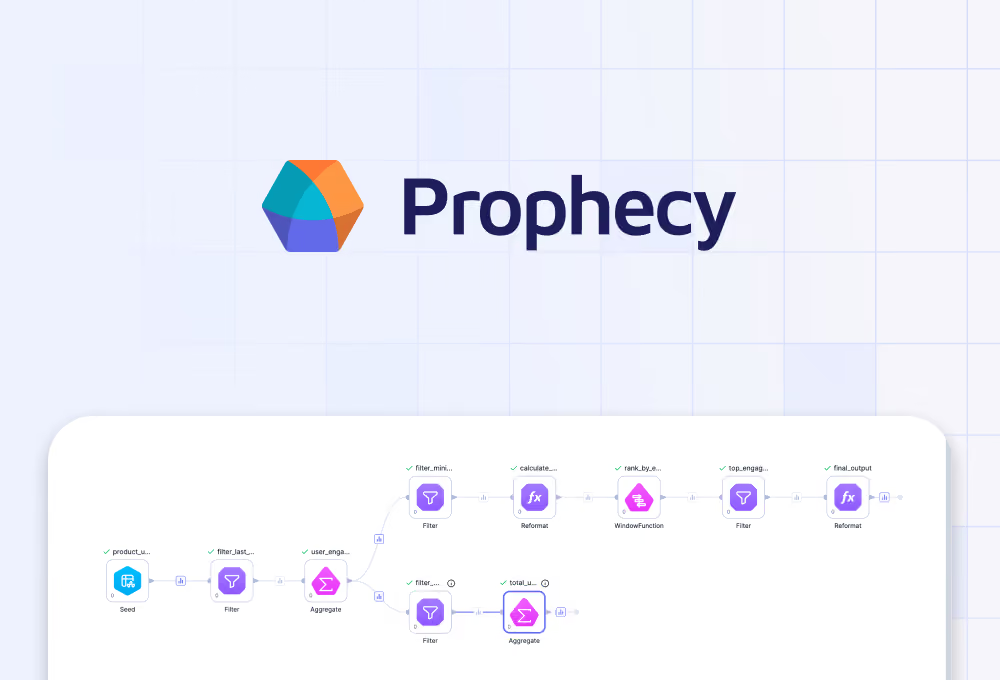
In Prophecy, an AI data prep and analysis platform, analysts can run any step of a visual workflow and profile its output, checking for nulls and outliers before the data moves on.
Also record where each source comes from and who owns it. If customer IDs start arriving blank, you’ll want the upstream system and contact name ready before the incident begins.
2. Set validation rules
Good validation rules turn business expectations into checks the pipeline can run every time data moves.
A date field might need a valid format and an approved range. A customer record might require an ID, country code, and account status before it can move downstream.
Attach a threshold, owner, severity level, and affected dataset to every important rule. A useful failure names what broke, how serious it is, and who needs to respond.
Prophecy’s built-in data tests put these rules inside the workflow. Analysts attach reusable checks to tables and columns, and the tests can run with each scheduled pipeline run.
3. Cleanse and enrich
Once profiling reveals the recurring defects, fix them as close to the source as possible.
Standardize formats, remove duplicates, correct invalid values, and fill missing fields from trusted reference data where appropriate. If five downstream reports all repair the same country-code problem separately, the real issue still sits upstream.
Reserve report-level patches for cases where the source can’t be changed quickly, and log each patch so it gets fixed upstream later.
In Prophecy, analysts can describe a cleanup, such as standardizing country codes, in plain English, and the AI agent drafts the steps as a visual workflow they can review one step at a time.
4. Monitor continuously
A dataset that passed its checks last month can fail tomorrow after a schema change, delayed load, or new source value.
Run validation on each load and watch freshness, volume, schema, and rule pass rates over time. Alerts should go to the person who can act, with enough context to judge whether the data should keep flowing.
Monitoring becomes especially valuable when many pipelines depend on the same source. For the operational side, the guide to keeping automated pipelines running covers how small teams can manage those checks without creating another manual queue.
5. Feed results back into governance
The final step closes the loop: What the alerts reveal feeds back into the rules, owners, and sources.
Review recurring failures, update thresholds, change ownership when responsibilities move, and retire rules that no longer reflect the business. Use incidents to improve the control itself. The best outcome is fewer repeated failures because the underlying rule, pipeline, or source system changed.
The 6 dimensions of data quality
Data quality assurance starts with a shared definition of “good” data, and UK government guidance recommends six dimensions to provide it, as defined by DAMA UK (the UK chapter of the Data Management Association) in 2013.
These six give your team one vocabulary for writing rules, scoring problems, and deciding which failures matter most.
- Accuracy: Values match the real-world facts they describe
- Completeness: Required fields and records are present
- Consistency: Different systems agree on the same fact
- Timeliness: Data arrives early enough for the decision it supports
- Validity: Values follow expected formats and business rules
- Uniqueness: Each entity appears once
A customer table, for example, might pass a validity check because every date is formatted correctly while still failing completeness because thousands of customer IDs are missing. The dimensions help you describe the problem precisely before deciding how to fix it.
For rule design, read the guide to building a data quality framework. For specific tests, use the seven essential data quality checks.
Data quality assurance owners and roles
| Role | What they own | What they sign off on |
|---|---|---|
| Data owner | Accountability for a business domain | Quality thresholds and accepted risk |
| Data steward | Definitions, rules, and issue triage | Rule changes and severity ratings |
| Data quality analyst | Profiling, assessments, and metrics | Baselines and quality reports |
| Data analyst | Fitness of data for reports and decisions | Results checked against expectations |
| Data engineer | Pipelines and automated checks | Fixes, deployments, and re-runs |
IBM notes that assessments may sit with data stewards, governance teams, or business analysts, while larger organizations may place overall accountability with a chief data officer or governance function.
Titles vary. The important part is knowing who decides whether the data is safe to use.
What happens when a data quality rule fails
When a data quality rule fails, the team should alert the owner, triage the issue, fix the source, re-run the data, and sign off on the result. A defined path keeps one bad value from turning into a long Slack thread with unclear ownership.
- Alert: Notify the rule owner and backup, naming the failed check and affected datasets.
- Triage: Rate the severity, trace the cause, and decide whether downstream use should stop.
- Fix at source: Correct the source system or pipeline step responsible for the error.
- Re-run: Run the affected pipelines and failed checks again, then refresh downstream datasets.
- Sign-off: Confirm the result and record the root cause, decision, and any rule changes.
Lineage speeds up the investigation. When a KPI gets challenged, lineage shows where the field came from and which downstream assets depend on it.
Without that trail, it’s easy to lose hours opening jobs, checking tables, and working backward through transformations.
Why data quality assurance matters
Data quality assurance matters because bad data affects decisions, productivity, compliance, trust, and AI output. The cost grows when errors travel further downstream before anyone catches them.
Gartner’s 2020 research found that poor data quality costs organizations an average of $12.9 million per year. A 2025 IBM Institute for Business Value report found that 43% of chief operations officers identified data quality issues as their most significant data priority.
- Decisions: Leaders can trust the numbers behind reports and dashboards
- Efficiency: Analysts spend less time tracing errors and cleaning repeated defects
- Compliance: Documented checks create evidence for audits and regulatory reviews
- Trust: Business teams are more willing to use shared data when someone owns its quality
- Analytics and AI: Models and downstream systems receive cleaner, more consistent inputs
Common data quality assurance challenges
Four problems commonly derail data quality programs: silos, unclear ownership, weak governance rules, and manual checks.
- Silos: Teams define the same field differently and produce conflicting numbers. Publish one definition for each critical field and assign a domain owner. Transformation logic that nobody can inspect makes the problem harder, which the guide on production-ready data prep explores.
- Missing ownership: A rule fails, and everyone sees the alert, but nobody owns the response. Name an owner and backup inside the rule itself.
- Weak governance rules: Policies sit in documents while pipelines keep running unchecked. Encode the important policies as validation rules and review failures regularly. The article on AI agent workflows that survive governance review covers what reviewers expect.
- Manual checks: Spreadsheet reviews take time and leave room for missed errors. Automate repeatable checks and keep human review for triage, exceptions, and sign-off.
Data quality assurance tools by category
| Category | What it helps you do | Examples |
|---|---|---|
| Profiling | Understand data shape, distributions, missing values, and anomalies before writing rules | Built into many data quality platforms |
| Validation and testing | Check whether data meets defined rules each time a pipeline runs | dbt (a SQL transformation framework) data tests, Great Expectations |
| Observability | Detect changes in freshness, volume, schema, and pipeline behavior | Monte Carlo |
| Governance | Record definitions, owners, policies, and lineage across datasets | Collibra, Atlan, Alation, Microsoft Purview |
The right starting point depends on where your quality process breaks today.
If incorrect values keep reaching dashboards, start with validation and testing. If failures appear without warning, observability should move up the list. If teams can’t agree on definitions or ownership, governance becomes the more urgent problem.
Most mature teams eventually use more than one category because profiling finds the issue, validation enforces the rule, observability spots change, and governance records who owns the response.
Where Prophecy fits in data quality assurance
Prophecy helps business analysts identify and resolve data quality issues while building transformation workflows before those issues affect downstream reports or analyses.
An analyst describes a goal in plain English, and Prophecy's AI agent builds a visual workflow on Databricks, Snowflake, or BigQuery. The agent unit-tests each step before it appears on the canvas. Analysts can run individual steps, profile outputs, and check for nulls or outliers.
Analysts can run individual steps, profile outputs, and investigate nulls or outliers. Built-in data tests provide reusable checks for tables and columns.
The advantage is catching problems where they originate. An incorrect join or unexpected null rate can be investigated during preparation, with the generated SQL available in Git for engineering review. Prophecy also has built-in data lineage features, so analysts can audit where a metric or field was used in any of their workflows, and make updates when issues arise.
Prophecy DataGPT extends this approach to ChatGPT, Claude, and Microsoft Copilot. Analysts can describe what they need in chat, review the generated workflow and its outputs, and approve it for scheduled execution on their cloud data platform.
Prophecy supports quality checks within data preparation and analysis workflows. Dedicated data quality and observability tools remain valuable for enterprise-wide monitoring, rule management, and incident response. Master data management (MDM) systems serve another purpose: keeping trusted records of customers, products, and other business entities consistent across systems.
Metrics that show data quality assurance is working
Five metrics give you a useful read:
- Rule pass rate: Percentage of checks or records meeting defined quality thresholds
- Freshness: Share of loads arriving within the agreed window
- Incident response time: Time from detection to resolution
- Ownership coverage: Share of critical datasets with a named owner and active rules
- Fix-at-source rate: Percentage of recurring problems corrected upstream
Look at the metrics together. A 99% pass rate means less if the remaining 1% sits unresolved for days, and fast incident response means little if the same source keeps breaking every week.
The healthier pattern is fewer repeat failures, broader ownership, and shorter resolution times.
Best practices and a copyable checklist
Data quality assurance gets stronger when the routine is boring in the best possible way: owners are known, checks run automatically, failures have a path, and recurring problems get fixed upstream.
Use this checklist to pressure-test the basics:
- List the datasets feeding your most important reports and models
- Profile each source and record a baseline
- Map every rule to a data quality dimension
- Assign an owner and backup to each critical rule
- Keep rules in version control beside the pipeline logic
- Include the failed rule and affected datasets in alerts
- Define severity levels and response targets
- Fix recurring errors as close to the source as possible
- Re-run affected pipelines after the fix
- Track pass rate, freshness, and incident response time
- Review repeat failures with owners each month
Starting data quality assurance this quarter
Start with the five datasets behind the reports people question most often. Profile them, define the rules, assign owners, automate the checks, and document what happens when one fails. Once the workflow holds up under real incidents, expand it to the next group of critical datasets.
{{cta}}
Frequently asked questions
What are the five pillars of data quality?
There isn’t an official set of five pillars of data quality. The most common framework uses six dimensions, defined by DAMA UK: accuracy, completeness, consistency, timeliness, validity, and uniqueness. Some lists leave out uniqueness and present the remaining five as pillars.
What does a data QA do?
A data quality analyst (data QA) checks data accuracy, identifies errors, and monitors quality standards. Their responsibilities include profiling datasets, creating validation rules, investigating failures, and working with data owners to resolve recurring issues.
What are the four types of quality assurance?
The four areas of quality assurance for administrative data used in official statistics are operational context, supplier communication, supplier quality checks, and producer quality checks. The UK Office for Statistics Regulation uses this framework, although it isn't a universal standard for all business data.
What is the difference between data quality assessment and assurance?
The main difference between data quality assessment and assurance is measurement versus prevention. Assessment identifies existing problems through profiling and testing, while assurance establishes the rules, processes, and monitoring needed to maintain reliable data over time.
How do you implement data quality assurance?
Implement data quality assurance in five steps: profile the data, write the rules, fix known defects, monitor continuously, and feed what you learn back into governance. Start with business-critical datasets, assign owners to investigate failures, and update validation rules as data sources change.