

Loan tapes arrive with inconsistent field names, definitions, and formats. Even after Regulation AB II, asset-level disclosure standards reach only SEC-registered deals; private-label RMBS now issues almost entirely under Rule 144A, where disclosure is negotiated deal by deal. The analyst is caught between a portfolio manager waiting for strats and a director waiting for pool options.
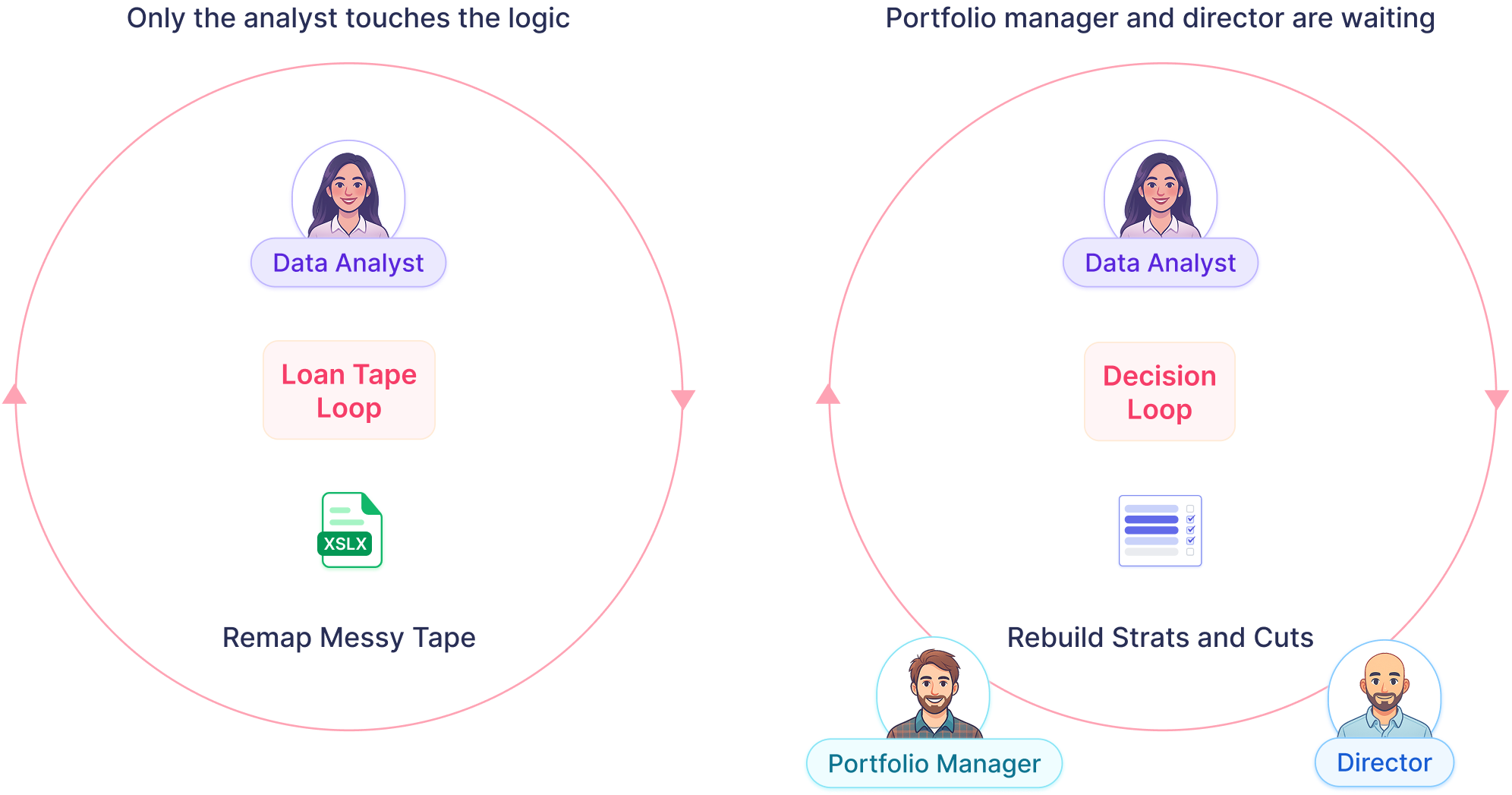
Two recurring loops slow the path from raw tape to portfolio decision. First, analysts do manual work across spreadsheets and legacy products that don't connect, so tape cracking and collateral validation run on tools never designed to talk to each other. Second, once the numbers are clean, analysts and portfolio managers cycle through rework, because portfolio managers can't change the analytics and route every follow-up back through the analyst.
Our agentic data preparation work with structured finance teams shows both loops persist while analysts alone own the mapping logic. AI compresses the first loop; a governed platform plus AI opens the second to portfolio managers without breaking review.
Why loan tapes slow portfolio analytics
Loan tapes vary because standards remain uneven across issuers and servicers. Some carry over a hundred data elements per loan; others only a handful. Industry efforts like the Prime Data Tape and the MISMO loan boarding dataset address different seams: the first standardizes at-issuance disclosure for prime RMBS, the second the origination-to-servicing handoff where boarding errors start. Neither is mandatory, and adoption is slow; the SFA tape replaced a 2009 predecessor, and the MISMO dataset is still at candidate-recommendation status.
Every new tape brings its own reconciliation problem. Common checks catch missing fields, blank values, bad formats, duplicate IDs, and dummy entries like "99999999999," and "No Data" placeholders, but it requires an analyst’s specialized knowledge to detect more subtle mismatches.
Picture a newly boarded servicer sending a tape with unfamiliar header abbreviations, delinquency coded on a servicer's own 0–6 status scale rather than MBA-method days past due, and missing FICO values throughout. The analyst has to reconcile all of it before the investment committee review, and that reconciliation eats the deadline week. On a live deal, the clock is tighter still: a credit manager evaluating a new offering may have only five to thirty minutes to get the tape organized and prepared; and that is just the front of the job, with strats, pool cuts, and cash flow and stress scenarios all sitting downstream of it. Enter the market late, and the deal is gone.
Loop one: manual tape work in disconnected spreadsheets and legacy systems
Tape cracking still runs in spreadsheets and legacy products, where small per-cell mistakes compound quickly into bottom-line errors that are hard to catch downstream. Regulators have flagged the spreadsheet problem for years: the Basel Committee's BCBS 239 principles expect risk-data controls at large banks to be as strong as those applied to accounting data, including where the work runs on manual processes and desktop tools.
Meanwhile, volume keeps climbing. Private-label RMBS issuance alone ran past $145 billion in 2024, none of it in the registered market where disclosure is prescribed, and more tapes mean more manual reconciliation. The manual process just doesn't scale.
Loop two: rework between analysts and portfolio managers
Even after the tape is clean, analysis moves in handoffs. The analyst runs ad hoc analyses and pool selection on raw inputs, then hands results to the portfolio manager. The director iterates on pool options, and on new-issue deals, a rating agency iterates on structure; every round landing back on the same analyst. Because the analyst owns the transformation logic, new questions route back as another workbook version: exclude that originator's 2022 vintage, then re-cut by geography.
A single pool-option review often starts with one exclusion request. The analyst re-pulls, re-filters, rebuilds the strats, and sends the next version. When the director then asks about single-state concentration, the same work repeats. Nobody in that chain is idle, yet the deal timeline keeps moving.
The person with the question can't touch the analytics, so every follow-up loops back through the analyst. Overcentralization creates bottlenecks and strips away business context, and the backlog grows faster than headcount.
How AI closes the first loop
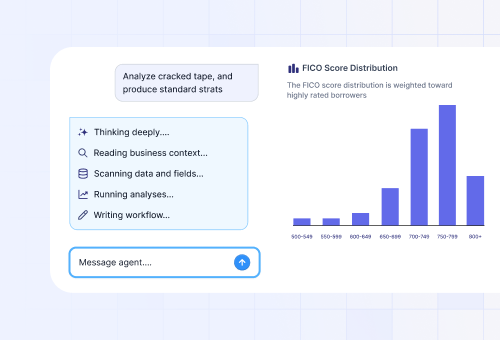
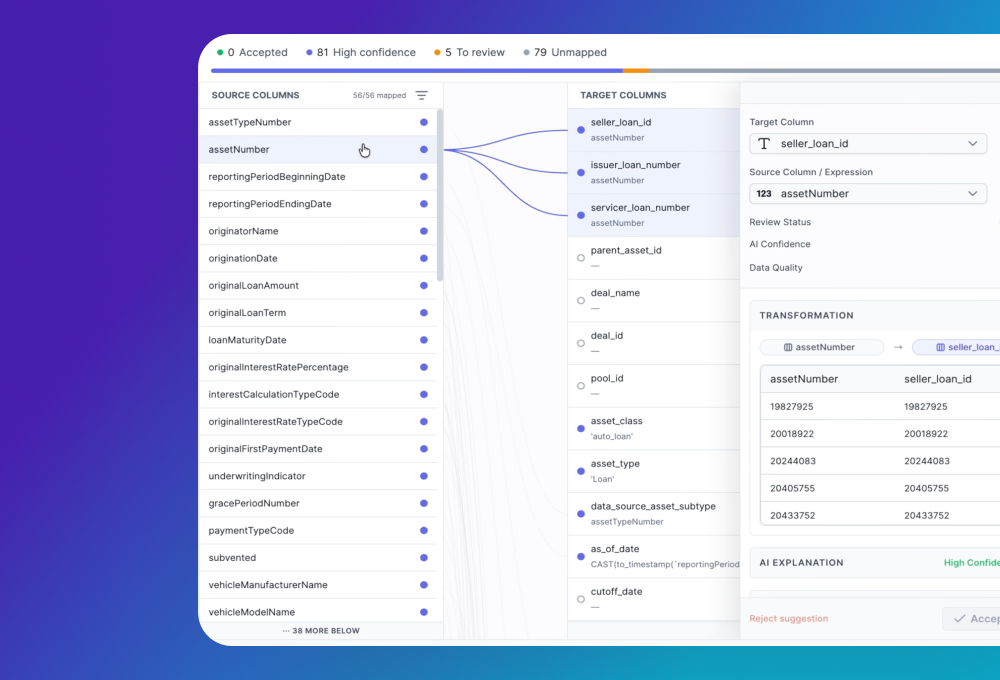
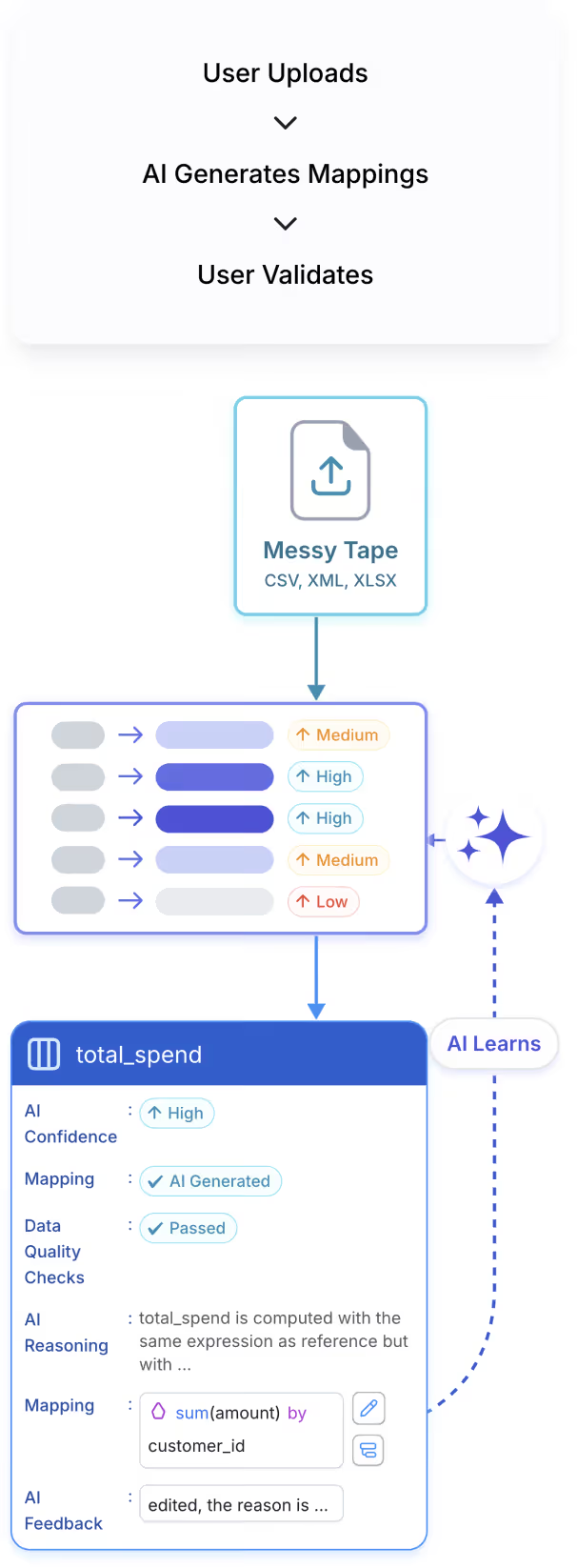
Agentic data preparation absorbs the manual mapping and cleaning that make up loop one. In Prophecy, a user uploads the tape, AI agents propose the field mappings, and the analyst confirms or corrects them. Approved mappings are retained and re-proposed on the next tape from the same originator, so accuracy climbs across successive tapes, and tape cracking becomes a quick review loop instead of a week of spreadsheet reconciliation.
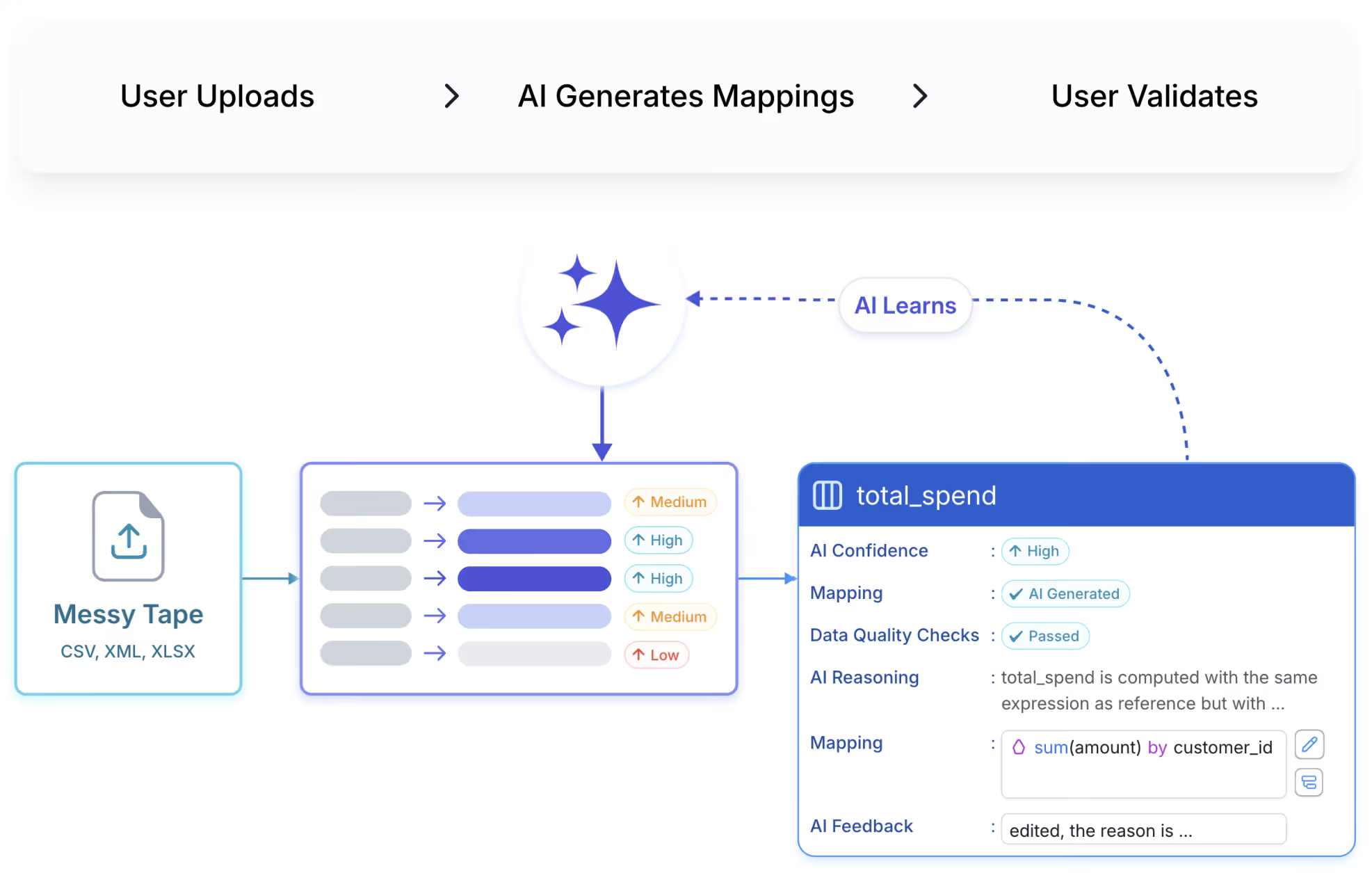
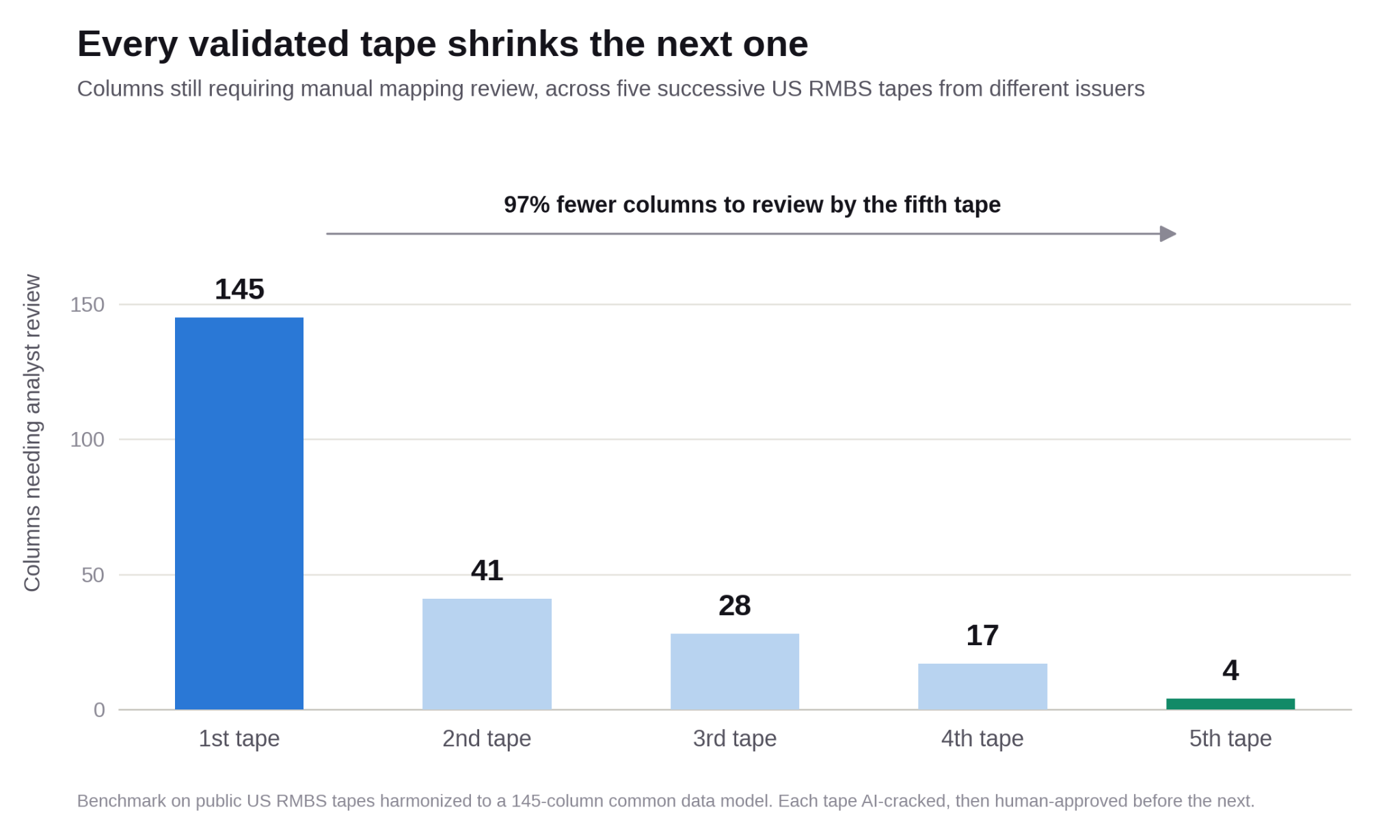
That progression is measurable. At one multibillion-dollar asset management firm running Prophecy in production, first-pass accuracy on loan tape harmonization ran above 90%, with human-in-the-loop review closing the remaining gap. Deal onboarding that had taken hours of analyst time now takes minutes. On a benchmark across public RMBS tapes from different issuers, the columns needing manual review fell from 145 on the first tape to 4 on the fifth tape.
Because Prophecy's agents generate visual data workflows that analysts can inspect, refine, and deploy, the person who knows what a delinquency bucket should look like stays in control of the logic. Keeping a human in the loop is what makes agentic AI safe to run in production.
The payoff shows up downstream. The same normalized fields feed roll rates, vintage curves, and concentration reporting, so the delinquency mapping is defined, reviewed, and corrected in one place rather than four. Once the analyst validates the mapping, every output inherits the validated logic, and the pattern extends into surveillance through standardized workflows that run on the cadence the team sets, so teams spend their time interpreting changes rather than rebuilding reports.
How a governed platform plus AI closes the second loop
Speed alone doesn't fix the second loop. A portfolio manager could always take a copy of the workbook and change it, but an off-system version can't survive an investment committee, audit, or diligence review.
A governed platform makes iteration across collaborators safe by default. Prophecy runs on top of your cloud data platform — whether Databricks, Snowflake, or BigQuery - with role-based access, audit logging, lineage, versioning, and clear review points on every workflow.
So when a portfolio manager adjusts a pool cut inside a governed visual workflow, AI agents generate the change and the platform versions it. Lineage and version history sit on the workflow itself, so the audit trail is a byproduct of the work rather than a separate task. The rework loop shortens because the person with the question can act on it, inside guardrails the platform owners set.
One of Prophecy’s customers describes the change as removing the linear process - the back-and-forth between the decision maker and the data provider - so that the data and the questions sit in one place.
The loops reopen every month
Both loops recur after pricing. The origination tape is only the first of three files a position generates: a servicer report arrives monthly, a trustee or distribution report follows it, and each one carries the same field-name drift, the same coding differences, and the same gaps as the tape that came before the deal closed. The mapping validated once at diligence is the mapping surveillance needs.
Warehouse facilities tighten the cadence further. A borrowing base certificate is a pool cut with a covenant test attached, run weekly or monthly against collateral that changes with every draw. The analyst who lost a deadline week to the acquisition tape now runs a smaller version of the same reconciliation on a schedule, and the rework loop with the credit and finance teams looks much like the rework loop with the portfolio manager.
This is where validated mappings compound. Once a deal was finalized, the same firm moved to monthly monitoring on the same workflows its analysts had already reviewed, scheduled runs, automated data quality checks, and alerts on structural changes in the incoming file, so data issues surface before they reach a downstream decision rather than after.
Governance is what makes an unattended monthly run worth trusting. Lineage and version history sit on the workflow, so a surveillance number traces back to the mapping decision that produced it and the person who approved it. That is the difference between a report that runs on a schedule and a report someone is willing to act on.
Start with the tape that hurts most
Pick the recurring tape with the most reconciliation work, or the deal where strat rework consumed the most cycles. Run it through Prophecy, validate the mappings once, and watch what the second and third tapes cost.
To try out Prophecy AI for structured finance automation, book a demo today and see the agentic data prep difference.