


This summer, I had the opportunity to intern at Prophecy, and I spent most of it on a project I genuinely loved: figuring out how our platform actually stacks up against the AI tools everyone keeps talking about. I walked in knowing very little about data engineering, and I walked out being able to design a real evaluation, defend my numbers, and present findings to the team.
The Opportunity
As AI assistants get better at answering data questions, more and more customers ask a fair question: "Why do I need Prophecy when I can just ask an AI?"
My job was to find an honest answer rather than a marketing answer. My manager, Edan, gave me the room to design the test myself, which was both exciting and a little intimidating as someone new to the field.
Instead of reading feature lists, I decided to put the platforms through the same real-world problem and score them side by side.
My Approach
I picked customer churn which means figuring out which shoppers are about to stop buying because it's genuinely hard. Computing it correctly means joining customers, transactions, and multiple time windows all at once, so it actually stresses a platform rather than testing a toy question. I used a public retail dataset of about 5,000 households and 21 weeks of transactions.
To make the comparison fair, I built a clear definition of churn and stuck to it: a customer counted as "churned" if they shopped at least twice in a 12-week window before a cutoff date, and then made zero purchases in the 8 weeks after. From there I broke the work into a sequence of seven prompts that built on each other, counting shopping trips, classifying every customer as churned, retained, or not scoreable, and finally ranking the highest-value churned customers a retention team would want to win back.
The key decision I made early on was this: I calculated the “right answer” myself first. Before testing any platform, I worked out the true churn numbers by looking at professionals' previous data analysis, so I had a neutral yardstick to grade everything against. The true answer was 259 churned customers at a 9.1% churn rate and every platform's response got checked against that.
I also built in a few “trap” prompts on purpose like asking for a column that doesn't exist, or using a vague term like “worst customers.” These tested the single most important thing about any AI tool: does it know the limits of what it knows, or does it just make something up? A trustworthy tool should say “that column isn't here, did you mean this one?” A risky one quietly makes an assumption and hands you a confident, wrong answer.
I scored each platform across five areas: accuracy, trust, how well it scales, whether it can run on a schedule, and what you keep if you ever walk away from the vendor. I ran the whole sequence across Prophecy, Claude, and Databricks Genie, and attempted Snowflake, tracking everything in a scorecard so the comparison stayed honest and like-for-like.
The Outcome
The results told a clear and honest story which was that the AI assistants were impressively accurate on the straightforward questions, and some were careful about flagging bad input; one even stopped and asked me what I meant instead of guessing.
But the platforms aren't really the same category. The AI tools answer a question once, in a chat window. Prophecy builds the governed, scalable pipeline that answers it every morning, at scale, on a schedule, in code you own, with a visual canvas a business user can actually see and run. That's the difference that matters for a real data team.
The traps were revealing: no single tool passed all of them. Some confidently invented answers to questions they couldn't actually answer, which is exactly the behavior you don't want when the output is headed into a business decision.
I felt like the last part was the most rewarding. When I presented to the team I felt like I was handing them something they could act on. And getting there meant a lot of trial and error: re-running tests, questioning my own numbers, and tracing a single wrong figure all the way back to its root cause.
What I Learned
A few things really stuck with me:
Being honest makes your work stronger, not weaker. My most credible finding was admitting where the competition did well. Conceding the true things made everyone trust the rest of my analysis and would help improve the product.
Precision matters. Early on I described a bug one way, then dug deeper and realized the real explanation was different. Going back and correcting it, being exact about what I could prove versus what I was guessing is what turned a shaky claim into a solid one.
You don't need to be an expert to add value. I started this summer not knowing what a pipeline really was. By the end, I was explaining the difference between a churn count of 259 and 304 to a room of engineers. The willingness to ask questions and check my own work got me further than any prior knowledge would have.
Beyond the Work
As much as I loved the project, what made this summer special was the people. And as cliche or cringy as it sounds it really is true.
My manager, Edan, set the tone for the whole experience. He was remarkably calm and helpful, especially in the moments where I made a mistake or went off in a direction he wasn't expecting. Instead of correcting me sharply, he'd walk me through it, help me understand why something went sideways, and let me find my way back to the right answer. That kind of patience gave me the confidence to take risks and ask “dumb” questions which, it turns out, were usually the questions worth asking. A lot of what I learned this summer only happened because I wasn't afraid to be wrong in front of him.
The other thing that stuck with me was lunch. I got to meet different people across the team. Everyone had their own background and their own path into engineering and hearing their stories was genuinely inspiring. Some came from traditional computer science routes, others took winding paths I'd never have guessed. Hearing how they got here made my own journey toward becoming an engineer feel a lot more possible. Those conversations were just as valuable to me as anything I built.
And of course, another highlight was getting to know the team outside the office, including a trip to Muir Woods I won't forget. It reminded me that great work happens alongside great people.
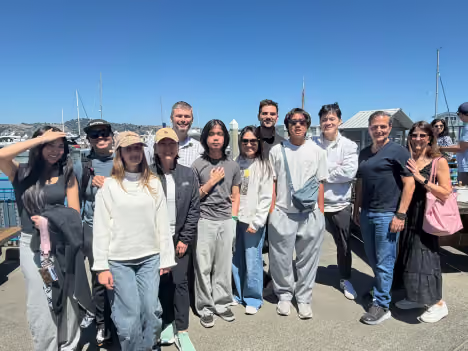
Thank you to Edan and everyone who made this such a meaningful summer. I came in curious and left genuinely proud of what I accomplished with the team’s help and a lot more sure of the engineer I want to become.


